



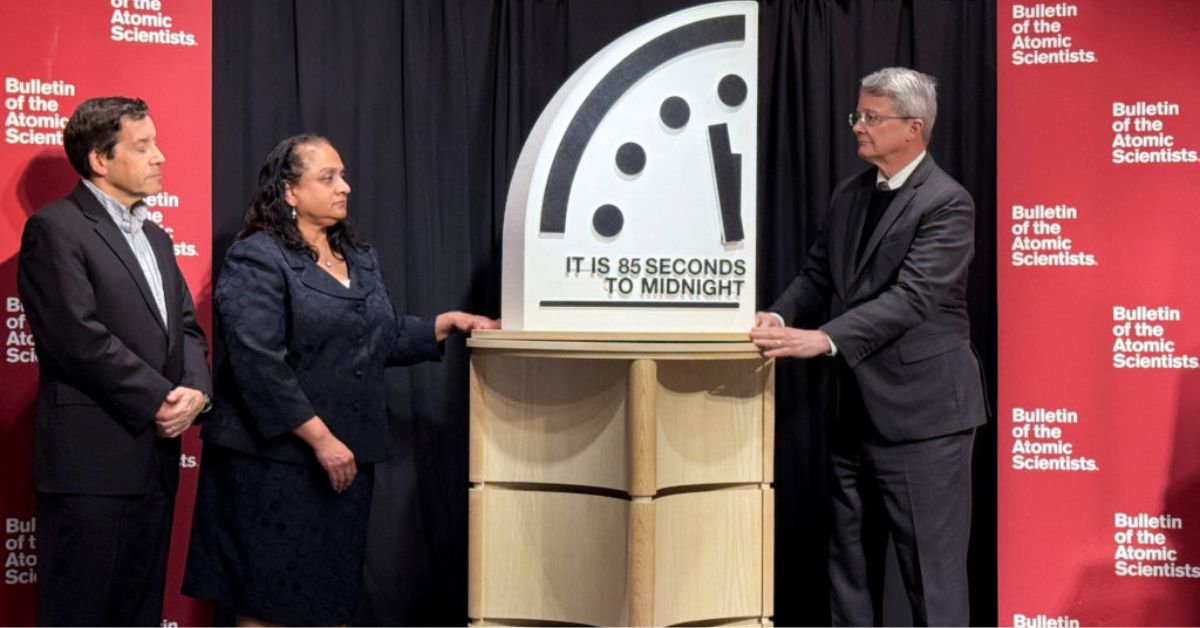
Scientists Move the Doomsday Clock to 85 Seconds to Midnight the Closest Ever in History
In January 2026 the Bulletin of the Atomic Scientists announced that the Doomsday Clock has been set to 85 seconds to midnight, the closest it has ever been since its creation in 1947.
This move reflects worsening global risks from nuclear weapons, climate change, biological threats and the rapid development of disruptive technologies such as Artificial Intelligence.
The Doomsday Clock update has once again drawn global attention as experts warn that humanity remains closer to midnight than ever before.
In recent years, the clock has hovered from moving to a historic low point to midnight in 2023 and remaining three though 2024 and into 2025.
At one point, it even stood at 89 seconds to midnight, underscoring how close humanity is to existential risk.
The Doomsday Clock is Set by the Bulletin of the Atomic Scientists and the Science and Security Board
The Doomsday Clock is maintained by the Bulletin of the Atomic Scientists, an organization founded by scientists from the Manhattan Project. The Bulletin operates in collaboration with experts from the University of Chicago, where it is based.

The decision to move the clock is made by the Science and Security Board (SASB) in consultation with the Board of Sponsors, which includes multiple Nobel Laureates.
These experts analyze global existential threats including nuclear risk, climate instability, emerging biosecurity risks and disruptive technologies such as Artificial Intelligence and cyber welfare.
Their goal is not to predict the future but to warn how close humanity stands to global catastrophe.
The Doomsday 2025 Clock Announces that the clock Remains at 90 Seconds to Midnight Signaling Extreme Global Risk
During the 2025 clock announcement, the Bulletin’s confirmed that the clock remains at 90 seconds to midnight, the closest it has ever been to symbolic destruction.
This position was first set in 2023 and maintained through 2024 due to escalating global instability.
The rising geopolitical tensions, modernization of nuclear weapons arsenals, climate inaction, and rapid technological disruption all contributed to keeping the clock closer to midnight.
The decision signals that global leaders have not taken sufficient action to reduce existential risks.
How 90 Seconds to Midnight is a Historic Warning
The shift to 90 seconds to midnight represents a historic low point in the clock’s history.

Over decades, time has moved forward and backward depending on global conditions. But the combination of nuclear risk, climate change and biosecurity risks has created a uniquely dangerous era.
During the Cold War, the clock once stood at 17 minutes to midnight, a significantly safer margin.
Today’s world faces multiple overlapping risks unlike past periods dominated by a single threat.
Experts warn that these compounded dangers push humanity dangerously close to irreversible consequences.
How Nuclear Weapons Increase Global Nuclear Risks in 2025
One of the most pressing concerns in 2025 remains the expansion and modernization of nuclear weapons.
Major world powers continue upgrading their nuclear arsenals, increasing the potential for miscalculation or escalation.

The growing nuclear risk is not only about war, but about unstable global diplomacy and weekend arms control agreements.
Experts argue that without renewed international cooperation, nuclear weapons remain one of the greatest nuclear threats to close humanity’s future permanently.
Why Climate Changes and Biological Threats Are Now Considered Major Existential Dangers
Climate change continues to intensify global instability. Extreme weather events, food insecurity and displacement increase political tension worldwide.
Biological Threats, whether natural pandemics or engineered pathogens, remain a serious concern.
The COVID-19 crisis revealed how unprepared global systems can be.
The Science and Security Board also warns about disruptive technologies, including AI and advanced biotechnology, which could amplify existing risks.
Together, these interconnected dangers from a complex web of threats that push the clock closer to midnight.
Since The Manhattan Project the Clock Has Moved From 17 Minutes to Just 90 Second
When the Doomsday Clock was first introduced after World War II, it stood at seven minutes to midnight.
During periods of diplomatic progress, it moved as far back as 17 minutes.
In recent years, 2023, 2024, 2025, the clock has remained at its most dangerous position. The continued presence at just moments from symbolic catastrophe reflects a sustained failure to address global risks.
Looking ahead in 2026, experts suggest that meaningful diplomatic agreements, nuclear reductions and climate commitments would be necessary for the clock to move backward.
Conclusion
The Doomsday Clock 2025 update is not a prediction of an immediate event, but a symbolic measure of how close we are to self-annihilation.
Set by leading scientists, Nobel laureates and security experts, the clock serves as a warning.
At 90 sec to midnight, the message is clear: without coordinated global action on nuclear weapons, climate change, and disruptive technologies, the world risks moving even closer to irreversible damage.
The Clock can move backward but only if decisive steps are taken.
FAQ
1. Who Controls The Doomsday Clock ?
The clock is set by the Bulletin of the Atomic Scientists through its Science and Security Board in consultation with its Board of Sponsors, including Nobel Laureates.
2. What does 90 seconds to midnight mean ?
It symbolizes an extremely high level of global risk, including nuclear war, climate collapse and emerging technologies threats.
3. Has the Clock ever reached Midnight ?
No, midnight is symbolic and represents global catastrophe, not a literal event.
4. Could the clock change in 2026 ?
Yes, if global risks decrease due to diplomatic progress or technological safeguards, the clock could move further.
AI Overview
The Doomsday Clock 2025 is a symbol of how close we are to destroying our world with dangerous technologies we created. Scientists in Chicago, who contributed to the first atomic bomb during the Manhattan Project, originally created the clock. Every year, the Bulletin of Atomic Scientists and its Science and Security Board, which includes nine Nobel laureates, set the time.
For 2025, the clock is set at 85 seconds to midnight, the closest it has ever been. It was previously reset to 90 seconds in 2023 and 2024. This new time reflects increasing tensions around nuclear arms, global instability, and heightened technological and biosecurity risks. It serves as a reminder of the dangers humanity faces.
