



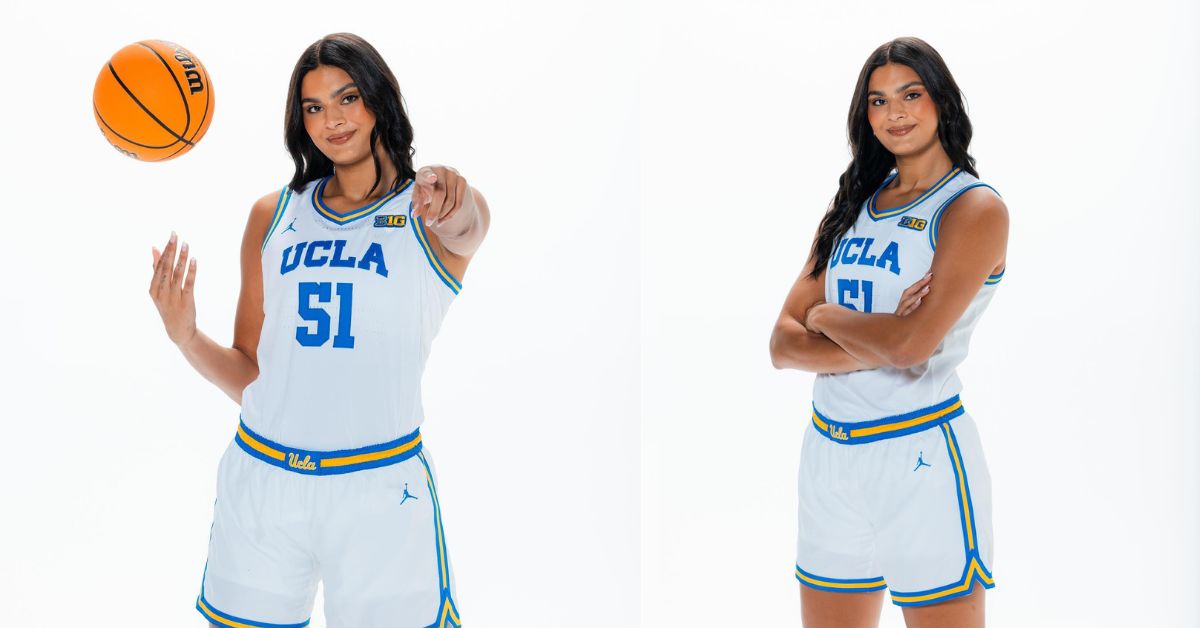
Lauren Betts mental health battle began long before she was the No. 1 recruit in America, and in January 2024, it landed her in a hospital hallway, alone, wondering if life was worth living.
She is 6 feet 7 inches tall, a First-Team All-American, and the newly crowned NCAA champion. But for UCLA center Lauren Betts, the most defining moment of her college career did not happen on a basketball court.
It happened in a hospital hallway, lying on a gurney at UCLA Medical Center, listening to the chaos of an overwhelmed psychiatric ward, wondering if life was worth living.
In a deeply personal essay published by The Players’ Tribune in March 2026, Betts laid bare the truth of her mental health journey, a years-long battle with depression and anxiety that nearly cost her everything.
The essay, released just weeks before she helped lead the Bruins to their first-ever NCAA title with a dominant 79-51 victory over South Carolina, immediately resonated across college sports and beyond.
“I don’t want to do this anymore,” she wrote in the Players’ Tribune, recounting the thought that broke through one morning during her sophomore year. “‘This,’ meaning life.” With those words, Betts became one of the most prominent college athletes in the country to speak so openly about suicidal ideation and the decision to seek professional psychiatric help.
“I know now how thin that line is between having your whole future ahead of you, and not. All it takes is one really bad morning.”
Lauren Betts
From Bullying to Breaking Point: Lauren Betts Mental Health Before the Spotlight
Lauren Betts spent her early childhood following her father, former professional player Andy Betts, across Europe.
The family relocated to Aurora, Colorado, when she was in the third grade. By that point, she was already 5-foot-6, and classmates wasted little time making her aware of it.
She was called “alien” and “giraffe,” mocked for her deep voice and her transatlantic accent, and left to navigate the particular cruelty of middle school while being impossible to overlook.
Basketball, introduced to her by her father, became her first real refuge. On the court, her height was not a punchline, it was a weapon.
“For once, people weren’t just looking at me because I was tall, It was like, well, she’s tall, and she plays basketball, and she’s the shit.”
Lauren Betts
The sport gave her somewhere to belong, and she excelled rapidly, becoming the No. 1 recruit in the 2022 class and earning a spot on USA Basketball’s national team at just 15 years old.
Yet even as the accolades accumulated, so did the psychological weight. After a difficult freshman year at Stanford, where she averaged just 5.9 points per game and, by her own account, felt both unproductive and unworthy, she transferred to UCLA ahead of the 2023-24 season.
The fresh start came loaded with unrealistic expectations she set for herself.
“I was still battling all the negativity and the self-hatred,” she reflected in the Players’ Tribune. “I was still very fragile. I couldn’t bend. So I broke.”
That breaking point arrived on an ordinary morning in January 2024. She called her trainer, was taken to the hospital, and checked herself into the psychiatric ward, a decision she described as the scariest and, ultimately, the most essential of her life.
“She’s beautiful. She’s talented. She’s successful. But on the inside, it didn’t match.”
UCLA head coach Cori Close
Recovery, Resilience, and a Championship Built on More Than Basketball
The road back was neither quick nor linear. Betts took time away from school and the team, with her mother staying in Los Angeles for a full week.
When she eventually returned to Pauley Pavilion, she addressed her teammates directly in the film room, no script, no spin, just honesty.
She told them she had been dealing with depression and that she was sorry for leaving. The response, she wrote, was immediate and unconditional: hugs, tears, and a collective exhale that she said physically lifted something from her body.
Therapy became a cornerstone of her recovery. Betts has been candid that she initially found the process uncomfortable, attending sessions almost daily during her most difficult period.
Over time, however, her therapist helped her reframe her entire relationship with mental health, stripping away shame and replacing it with self-awareness. “My mental health isn’t perfect,” she acknowledged. “It’s an ongoing project.”
UCLA coach Cori Close, who was present at the hospital that first night, praised Betts’ courage in remarkably direct terms at a press conference following the Players’ Tribune piece.
“I cannot imagine, when I was that age, having that kind of courage. It’s incredible to watch how she’s grown and healed in miraculous ways.”
Cori Close
“It’s incredible to watch how she’s grown and healed in miraculous ways.” Even South Carolina’s Dawn Staley, a coaching rival, reached out privately to Betts during her lowest period, a gesture Betts highlighted in her essay as unexpectedly meaningful.
On April 6, 2026, Betts capped her college career with that championship trophy in Phoenix, contributing 14 points and 11 rebounds in the title game.
Yet the victory felt inseparable from the deeper story. As she put it after the win:
“For me, it’s not really about the wins and the losses, it’s about this entire journey that we’ve had together.”
She is projected as a high first-round pick in the WNBA Draft on April 13, but her most lasting impact may well be measured not in statistics, but in the athletes, young women, especially, who heard her story and felt slightly less alone.
“I was put on this earth to do more than just play basketball. The journey I’ve had and the hardships I went through are to help other people.”
Lauren Betts
If there is a single through-line in Lauren Betts mental health narrative, it is this: asking for help is not weakness, it is, as she proved, the prerequisite for everything that comes after.
FAQs
What is Lauren Betts’ ethnicity?
Lauren Betts is an American of mixed heritage. Her father, Andy Betts, is African American and played professional basketball in Europe, while her mother is white.
Who are Lauren Betts’ parents?
Lauren Betts’ parents are Andy Betts, a former professional basketball player, and her mother, whose first name has not been widely publicized. Andy’s career in Europe is why Lauren spent her early childhood in Spain before the family relocated to Aurora, Colorado.
How tall is Lauren Betts?
Lauren Betts stands at 6 feet 7 inches tall. Her height, which drew bullying and cruel nicknames growing up, ultimately became her greatest athletic asset as a dominant center in women’s college basketball.
Does Lauren Betts have a brother?
Yes, Lauren Betts has a brother, Dylan, and a sister, Sienna. The three siblings grew up together, spending much of their early childhood traveling across Europe while their father played professional basketball.
What is Lauren Betts’ net worth?
Lauren Betts’ net worth is estimated at $500,000 to $1 million as of 2026, largely driven by NIL deals during her college career at UCLA. With her projected status as a high first-round pick in the 2026 WNBA Draft on April 13, her earnings are expected to rise significantly.
